One hill,
three ages of a single work
From an Alsatian Spiritan mission to the college raised by Marist Brothers who came from Quebec: the living memory of Collège Stoll d'Akono and of the Saint Joseph Minor Seminary that prepared its ground.
Raised upon the seminary's foundations
Collège Stoll did not rise from untouched ground. It stands on the very site once largely occupied by the Akono Minor Seminary — upon a mission founded by an Alsatian Spiritan and carried forward by Brothers who came from Canada. Three institutions, one patronage, one enduring soil.
Father Antoine Stoll arrives in Cameroon
A Spiritan from Gingsheim in Alsace, he mastered French and Ewondo aboard the ship that bore him south. A curate at Minlaba, he came to Akono in 1923 to relieve the ailing Father Braun. The mission was founded that same year; he would shepherd it as parish priest until 1943.
The Church of Our Lady of the Seven Sorrows
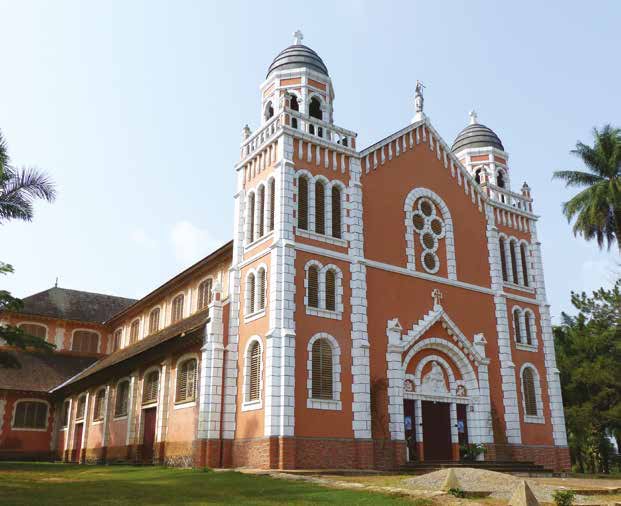
Brother Alphonse Quémeneur, an engineer, raised a church of cathedral proportions to Father Stoll’s designs: 70 m long, 40 m across the transept, a 25 m façade, room for more than 3,000 faithful, and acoustics without equal. Beaver-tail tiles, brick and timber — Alsace transplanted to Beti soil.
Saint Joseph Minor Seminary
Founded by Bishop François-Xavier Vogt, the first French bishop in Cameroon. Renowned in its day, it formed an elite — the future president Paul Biya among them — until its transfer to Yaoundé in 1972. The Sisters of the Cross of Strasbourg joined the mission in 1934; their Mother House rose in 1946.
The Marist exodus from the Congo
Driven from Congo-Brazzaville by the Marxist regime, Marist Brothers from Quebec fled under cover of night with a tractor and a red trailer. Archbishop Jean Zoa received them “with open arms” in Yaoundé and confided to them a college then finding its feet in temporary quarters: Collège Stoll.
The birth and raising of Collège Stoll
Founded by Archbishop Jean Zoa, first in wattle-and-daub rooms behind the presbytery. The permanent works fell to Brothers Paul-André Lavoie and André Côté. In under two years, a campus rose from the forest floor. The college bears the name of the mission’s founding priest.
The official inauguration
Collège Stoll was inaugurated by Mr Paul Biya, Secretary General of the Presidency of the Republic of Cameroon — and once a pupil of the Akono Minor Seminary — before the Ambassador of Canada and the Apostolic Nuncio. Three weeks earlier, Father Antoine Stoll, unable to attend, had answered the invitation from Alsace in a letter dated 2 February 1969.
The departure of the Marists
For want of sufficient Canadian brethren, stewardship passed back to the Archdiocese of Yaoundé. Brother Potvin spoke with grief of “the decline of a work begun in enthusiasm.”
A heritage awakened & the seminary reborn
The GESCOD / Alsace partnership set in motion the restoration of the church and the mission. Under Archbishop Jean Mbarga, Saint Joseph Minor Seminary reopened at Akono in 2018 with 194 seminarians. A precedent that lights the way for the struggle of today.
The church, from which the whole work sprang
A cathedral deep in the bush
Raised between 1933 and 1938 to Father Stoll's own designs and under the hand of Brother Alphonse Quémeneur, an engineer, the Church of Our Lady of the Seven Sorrows is reckoned across Cameroon and the wider region among the noblest monuments in the history of the Catholic faith. Beaver-tail tiles, brick and timber — the building craft of Alsace, transplanted into the equatorial forest.
It was this church that gave the place its soul. The painter Atini Charles, whom Brother Lavoie discovered as he was at work painting the Akono church, would in time adorn the walls of Collège Stoll itself.
Here Father Stoll would say, again and again: “The things of God must be handled with reverence.” Those words, incised in the Ewondo tongue, keep watch to this day over the college gate.
A child of the hill returns to consecrate it
The photograph tells the whole story of Akono. The man who inaugurates Collège Stoll on 23 February 1969 — Mr Paul Biya, Secretary General of the Presidency of the Republic of Cameroon — had himself been a pupil of the Saint Joseph Minor Seminary of Akono, the mother house raised on this same hill. A child formed on this ground returns, now as an envoy of the State, to consecrate the new work that carries the old one forward.
About the table, the three pillars stand united: the Cameroonian State, the Church in the person of the Apostolic Nuncio, and the Canada of the Marist Brothers in the person of the Ambassador. From seminary to college, the hill of Akono here redeems its every promise.
Three weeks earlier, Father Stoll himself — invited from his retirement in Alsace — had answered in a letter dated 2 February 1969, moved that a college should bear his name, “a college of which he had dreamed in his years as parish priest.”
A pantheon of founders and masters
Seven faces, seven lives spent upon a single work — from the Alsatian Spiritan to the Quebec chronicler, from the founding archbishop to a figure cherished only in living memory, and on to a former pupil who became an artist of worldwide renown. The pantheon of those who made Stoll — and whom Stoll sent out to shine.
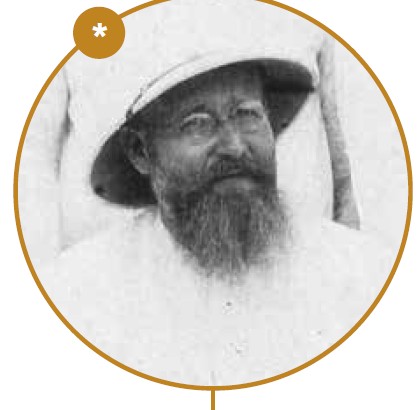
1890 – 1973 — The namesake. “A giant of the mission.” Its founder in 1923, parish priest until 1943. He returned to Alsace in 1940 and rests at Wolxheim.
What the chronicle handed down to us
The account of Brother Laurent Potvin, an eyewitness to it all, gives this history its flesh and blood. Three passages form its beating heart.
“Pupils would say to him: We shall never see this college! He would answer: If you do not see it, your children will behold it one day, and reap its fruits!”
On the clearing of the equatorial forest by machete, 1963“We are Marist Brothers. We wish to share in the development of your country through the education of its children.” — Go on! You are welcome. Come through!
At the Cameroonian frontier, after the flight from the Congo, 1965“Though we look on with sorrow at the decline of a work begun in fervour, we trust it will know exalting days to come in the hands of Cameroonians eager to carry forward the education of the young.”
Br. Laurent Potvin, entrusting the future to the alumni — 2003⚠ SOS Collège Stoll — a heritage in peril
Fifteen hundred pupils in 2004. Fewer than two hundred today.
A school built for two thousand of the young has been emptying ever since the Marists departed. A heritage does not die of old age — it dies of neglect. What Stoll once formed must now, in turn, carry Stoll.
Keepers of an inheritance, builders of what comes next — the hour to act is now.
What Stoll possessed — and what it has become
This document, filmed on the ground, lays bare the depth of the fall.
Collège Stoll was no ordinary school: it was a self-contained, modern, self-sufficient whole, at the very edge of its age.
A vast material and human inheritance, now imperilled:
All of it once existed, functioned, formed one generation after another. All of it, today, stands on the edge of oblivion. That is why the call can wait no longer.
Stoll & Akono, in motion
Heritage is not only read; it is watched, alive. These films gather the many gazes cast upon the college, the mission and its estate. Press ▶ to begin each film.
The estate and its stones
Fourteen hectares deep in equatorial forest: the jewel of a church, the two campuses, the boarding houses, a sports complex without equal in the region. Add images here as they are recovered or newly photographed.
Where the memory may be drawn
The archives, collections and films to be sought out in order to complete this record.
Marist chronicle
Laurent Potvin, fms, L’Afrique aux mille couleurs (Château-Richer, Quebec, 2003). The testimony of the founding witness.
GESCOD brochure
Akono, un patrimoine & une histoire à partager (2017). Photos © Michel Weyland; exhibition “Akono, a century of shared history with Alsace (1906–2016).”
Spiritan archives
Chevilly-Larue (Paris). Portraits of Father Stoll, Brother Quémeneur and Bishop Vogt; photographs of the church under construction.
Marist archives
champagnat.org & the Canadian province. Brothers Lavoie, Côté, Tardif and Aubut; photographs of the period.
Reference book
F. Zambo Onana, La paroisse d’Akono — Un héritage alsacien en terre camerounaise.
The alumni themselves
The most urgent source of all: testimonies, class photographs, figures such as Messi Évariste “Iso.”
Petition “60 years of Collège Stoll” (2023)
On Change.org: the first SOS raised for the sixtieth anniversary, summoning alumni, parents and the Marist community to save the college.
Filmed documents
“Le Collège Stoll d’Akono” (Antheal Vision, 16 min) and video reports upon the estate and its heritage.
Those whom Stoll once moulded are now called to uphold it
This is no longer a petition; it is a pledge. In joining the alumni network you write your name into the chain that binds the first class to those yet to come. Every membership counts; every gesture saves a little of the house.
Everything now happens in our Facebook group. Join it: reconnect with the alumni, follow the news, and post your photographs and memories freely.